
Camp Occohannock on the Bay Changing Lives for 68 Years
By Bill Sterling
In the Beginning
The 50 acres of land that are home to Camp Occohannock on the Bay is sacred ground. It is where lives have been transformed, from campers to counselors, ever since the property situated along Occohannock and Tawes creeks was purchased for $28,000 by the Eastern Shore District of the United Methodist Church in 1958.
But long before that, legend has it Captain John Smith might have navigated the creek. It is known for certain Col. Edmund Scarborough, one of the most prominent of the early English settlers on the Eastern Shore, lived just a stone’s throw from the camp. Scarborough, speaker of the House of Burgesses, served on the Governor’s Council and was the county sheriff, a lawyer, planter, surveyor, merchant, ship owner, militia colonel, and as one story goes, no friend to the Indian.
Jonathan Seidel, who was the camp’s waterfront coordinator, counselor, and lifeguard during his time in the early 2000s, feels the location of the camp is integral to its impact on those who attend and work there. “The camp’s most valuable asset, aside from the people of faith, and the providence of God that make it run, is its setting on the precipice of the shore and the Chesapeake Bay. It is a unique natural gateway to nature’s beauty and bounty. The shoreline just north of the camp closely resembles the way it appeared to the native inhabitants and first settlers centuries ago. In that, it offers a unique glimpse not only into the past, but to the glory of our Creator.”
Seidel recalls using the local waterways was a bonding adventure in his time at Camp OOTB. “While I was at the camp, the focus was on small group outdoor ministry. I was fortunate to help lead multi-day sailing trips to Silver Beach, the Pocomoke River and excursions out to Savage Neck Dunes and Metompkin Island with campers and staff. These were all great experiences to minister to the campers in a natural and dynamic setting.” Seidel was also known and remembered for dressing up like a pirate and hiding treasure for the kids to find.
Tanner Serves at Turning Point of Camp History
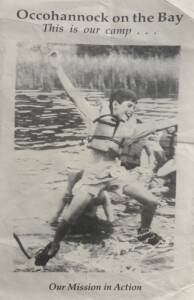
Rev. Doug Tanner was a campus minister in North Carolina when he developed a vision of a retreat that offered natural beauty and an opportunity to ponder the call of discipleship.
In 1979, Tanner rented Camp Occohannock for two weeks with a small group of friends and hosted a retreat on “Simple Living” and then organized a week-long camp in partnership with the Association for Retarded Citizens on the Eastern Shore. He returned for a third week to help director Rev. Carl Paugh conduct a junior high camp for the Eastern Shore District.
Tanner says those three weeks changed the course of his life. “Camp Occohannock set its hook in my heart that summer. Seven years later, I enthusiastically found myself ‘reeled in.’ Along the way, I concluded my first marriage, managed a successful campaign for Congress, served as a Congressional aide, and transferred my United Methodist Annual Conference affiliation from Western North Carolina to Virginia. With support from Eastern Shore District Superintendent Warner Crumb, I was appointed pastor of Belle Haven and Craddockville churches, with the understanding that I hoped to help expand Camp Occohannock into a retreat center for adults as well as a camp for children and youth. I also strongly sensed a calling to develop a retreat ministry among people professionally engaged in national politics.”
Tanner served Belle Haven and Craddockville from 1985 to 1987, then became the camp’s part-time residential director from summer 1987 to summer 1988. Tanner longed to stay beyond that one year, but in 1986 he had married a Congressional aide whose work was focused on ending the wars in Central America. Initially, his wife managed to travel back and forth from Washington to the Shore easily enough. When her role on Capitol Hill became increasingly demanding, though, Tanner found it more difficult to manage their lives so far apart. In 1988, he joined his wife in Washington and eventually founded The Faith & Politics Institute — in keeping with a major dimension of the calling that had led him to Camp Occohannock.
Tanner knows he left behind a maelstrom and was perceived as persona non grata in some quarters. “In my one year as director, some major decisions were made by camp leadership regarding a range of improvements, and the financing required incurred a significant indebtedness. It is my understanding that after I left, the debt occasioned considerable debate in the Eastern Shore District over whether to pursue an adequate fundraising campaign or to sell the camp.” Adding to the angst was the fact that the Executive Committee of the camp made the decision to borrow the money without securing approval of the District Council on Ministries for the United Methodist Church of the Eastern Shore.
Some leading clergy called for the sale of the camp to eliminate the debt they were facing, but others felt the natural beauty and uniqueness of the land merited patience and a fundraising campaign that would eventually eliminate the debt.
Today, the camp resonates with a vibrancy comparable to that which Tanner foresaw — albeit without the retreat offerings he envisioned for public officials and political professionals. He recalls, “I learned in the course of my tenure as director that United Methodist politics in the Eastern Shore District could be as complicated and complex as national politics in Washington. In retrospect, I think the crisis that emerged helped the camp turn a critical corner. The beauty of its sacred site on the Bay is a rare treasure. The way the camp is thriving now makes my heart sing!”
Many Groups Begin to Use Camp OOTB as Base for Activities
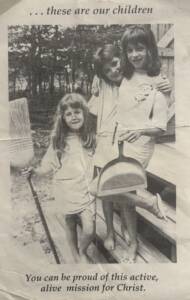
Harvest of Hope began sending volunteers to stay at Camp OOTB during their mission to glean the local fields. For many years, Camp OOTB hosted the Special Needs Camp with ARC, bringing developmentally disadvantaged youth for a week of fun activities and socializing. Camp OOTB also began a site for All God’s Children, a camp ministry established by the Virginia Conference to serve campers who had an incarcerated loved one in their immediate family. This special program was well received and made an impact on many families.
Boy Scouts often used Camp OOTB through much of the camp’s history. Scouting also had a significant impact on the program design for summer camp. It included meals served family-style and campers broken up into groups called units. In addition, Eagle Scout projects took place at the camp, including a children’s playground and an archery range built by local scouts from Troop 313.
Another significant participant in the camp was the Eastern Shore Emmaus. The Emmaus Walk is a four-day gathering that seeks to inspire, challenge, and equip leaders of Christian action in their churches, homes, places of work and communities. The first walk took place in 1992 after the pastor and several members of Franktown Methodist Church had attended Emmaus walks in the Tidewater area. Eventually, there were enough Emmaus Walk veterans to start a walk on the Eastern Snore. The consensus was that Camp OOTB was the ideal location to hold such a walk.
“It’s not a retreat,” explains Frank Walter, the 2026 Community Lay Director of the Eastern Shore Emmaus Walk Board of Directors. “It’s an opportunity for spiritual renewal,” adding his Emmaus Walk in 2017 “had a profound impact on my Christian life. We consider Camp Occohannock to be holy ground for all the changes it has brought to over 3,500 pilgrims who have attended an Emmaus Walk in the past 34 years.”
The Emmaus community had a significant impact on Camp OOTB and was heavily vested in designing and erecting the worship center located on the property. The worship center was built around 2007 and has been utilized heavily because of its functionality and incredible view of Occohannock Creek and the Chesapeake Bay.
Camp Experiencing Growth
Rev. Joel Coleman arrived in September 2021 as camp director. His transition to the camp brought new energy and leadership that allowed the camp to thrive. Since 2021, the camp has been blessed to set a new record for summer camp participation and retreat groups. In 2026, summer camp reached a record high of 610 campers in the day camp and residential program. Retreats and usages also have increased each year.
The camp has added a host of new amenities and activities, which include a commercial playground, zipline, tree climbing, jumping pillow, and laser tag. They have begun working on relaunching their sailing program, with a building addition forthcoming to help house and repair boats, as well as a better maintenance program.
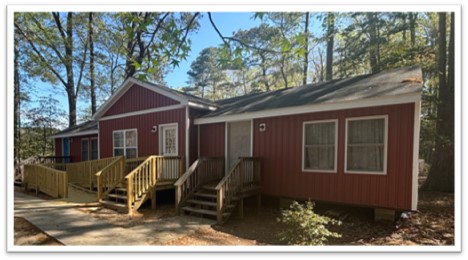
During Coleman’s time, the camp has added two new “super cabins.” The vision came through discussion with Pastor Bob Talbott serving Craddockville and later Franktown United Methodist Church. His brother David Talbott collaborated and offered his engineering and design skills.
Coleman and the Board of Directors took 2025 to work through a vision and planning process for the future. Through those retreats, the camp settled on the vision to be a vibrant outdoor Christian community where everyone experiences God’s abundant love through faith, friendship, and creation. The team saw a vision of serving 1,000 summer campers by 2030, as well as establishing facilities that will house retreat groups overnight for up to 200 people. Coleman’s enthusiasm for the camp and the ministry is contagious.
The camp has expanded its impact through mission trip opportunities, field trips, newly established groups, in addition to its thriving summer camp program. Coleman is excited about the growth and changes happening at Camp Occohannock, but regularly declares that it could not have been possible without the work of many volunteers and the Holy Spirit!
Early Campers Found Natural Beauty, Rustic Cabins
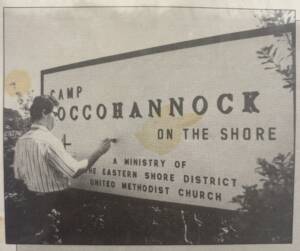
The first campers at Camp OOTB came in 1959, staying in rustic cabins and using outdoor privies. The camp began as a district camp under the Eastern Shore Board of Missions and operated by a group of board members, which extended to a representative in each United Methodist local church. In the early days, activities included swimming, fishing, group games, rustic camping, nature experiences, and survival skills. Pastors from local churches served for a week as the dean of the camp.
I attended overnight camp at Camp OOTB for the first time in the summer of 1964. That summer, my mother was giving birth to my younger brother and caring for a 2-year-old son. Because I was a member of Craddockville United Methodist Church, which was located less than three miles away, we viewed that place almost as our personal playground, where picnics, softball games, sunrise services, and other activities were held. I was 13 that summer, and I remember looking up to the male counselors, who seemed so worldly and possessed remarkable strength and agility running the obstacle course and engaging in physical activities. That was a formative period of my life, and the spiritual lessons I learned at Camp OOTB while participating in a variety of activities helped shaped me for the course of my existence.
Betty Belle Groton Flowers recounts her experience at the camp in the early days. She had the opportunity to be part of the very first group of campers on the grounds. She credits her church and the camp as the foundation of her life. “Craddockville Methodist Church was my anchor during my youth! I was in the youth choir, Sunday school class, Methodist Youth Fellowship and was in the very first group of campers at Camp Occohannock. In fact, I remember when I was 10 years old the first ‘gathering.’ Most, if not all, the youth from Craddockville church were there during that summer. We had to have a ‘partner’ to walk out in the creek with and I was assigned Wayne Custis. We went ‘snipe hunting’ out in the woods. I never saw one and to this day don’t know what they look like. We sat around bonfires and talked. We bonded. We had each other. The camp was very primitive. I even remember the outside toilet. So many memories of a very special place.”
Long after she was among those first campers, Flowers maintained contact with the camp. “Dad farmed the land directly across from the driveway to Camp Occohannock. Now there are houses there. I would go with Mom to carry Dad his lunch on the farm and walk on over to the camp just to be there.”Flowers adds, “Little did I know that Craddockville church and Camp Occohannock would serve as a solid foundation for my entire lifetime! It was here that I learned of God’s love.”
Camp Occohannock Serves Diverse Groups
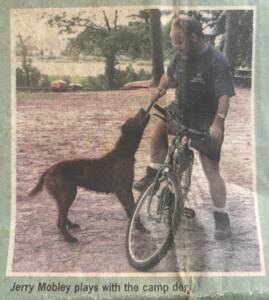
Part of the camp’s history includes programs that served adults from the Eastern Shore for mission work. Jerry Mobley first came to the camp in 1994 through a week-long mission trip to build homes in the area for Habitat for Humanity.
Struck by the beauty of the camp, Mobley left a 25-year career as a truck driver to become the camp director from 1998 to 2000 and then again from 2004 to 2013. “My time at Camp Occohannock began as employment and very quickly grew to be my ministry serving God’s children who came,” said Mobley. Asked what was the highlight of his time at the camp, Mobley replies, “Each day that I spent on God’s Holy Ground.”
During Mobley’s time at the camp, activities such as low ropes, a climbing wall, and biking were introduced to the camp. Also, campers played simple games of going to find a block of wood called Bonzo. Bonzo became part of camp lore, as well as the Wampascat, a mystical character, who still is talked about among campers today.
In the ’90s, Barry LeNoir, was the Summer Program coordinator for three years. He was instrumental in utilizing local waterways more by increasing the activities of canoeing, sailing, and kayaking at the camp. This was at a time when summer camp’s attendance began to increase. There were canoe trips to Chance Beach with overnight campouts on the Chesapeake Bay. LeNoir remembers how special those memories were to his experience, including the competitive spirit when canoes crossed paths with boats from nearby Camp Silver Beach.
LeNoir also fondly recalls “Miss Emily” Bundick, the camp’s cook for many years. “Miss Emily’s ‘holy hospitality’ was legendary, and she would barter her bread and cinnamon rolls for bushels of crabs, loads of corn-on-the-cob and TONS of summer squash, zucchini, tomatoes, and other vegetables, which kept us fed well.
Under Lenoir’s leadership, Camp OOTB hit some of its highest attendance in camp history, serving around 300 campers during the summer. LeNoir went on to Camp Bethel and utilized the same camping approach with that sister camp in Fincastle, Va.
Camp OOTB is Still Changing Lives
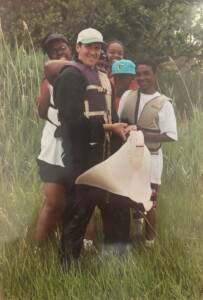
Camp OOTB seemed to have a profound effect on those who worked there. Michael Henry was a camper, a senior counselor, Summer Program coordinator, and finally the camp director for six years. He talks about his time at camp OOTB in this way: “It was the one place that I knew I could hear about God every day and that it was OK to say his name. Knowing and finding God was truly a lifesaver. The world is tough when you are young, and camp allowed me to get away from those things and kind of start over with new faces.”
During Henry’s time at the camp, campers had the opportunity to experience the Appalachian Trail through a partnership with Camp Bethel (Director Barry LeNoir). It was a camper exchange of sorts, where kids from the Shore experience the mountains and kids from the mountains came to the Shore.
Cameron Mears remembers his years at camp under Michael Henry fondly. He was a camper in elementary school and later a counselor and then a lead counselor for five years. “Camp OOTB truly led me to live a life as a Christian. OOTB is where I realized I truly wanted to be a Christian.”
Timeline Events
January 10, 1959: Meeting of the first development group for Camp Occohannock.
June 1959: First Campers at Camp Occohannock
June 1960: Open House at which time there were two lodges and a picnic pavilion
1961: Construction of a shower house and two more lodges.
1962: Lynch building was built which serves as the main meeting area
1968: Some small boats purchased
1981-82: A Norfolk architect toured Camp Occohannock with representatives from camp and a long-range general plan for the camp was developed.
1982: The District Conference passed a resolution effective
1984: That the District would go forth on faith to raise a minimum of $3.00 per member for each year of a three year period for the development of Camp Occohannock.
1988: Four new cabins were built surrounding a new bath house.
1989: Occohannock on the Bay owed Crestar Bank $180,000. A five year fundraising campaign was started which resulted in raising over $200K for the camp.
April 1994: A note-burning ceremony was held at the camp to celebrate the retirement of our camp indebtedness with Crestar Bank
January 1996: “A Vision Shared”, the Long-Range Plan concept, was endorsed by the Occohannock on the Bay General Board and the District Conference. Since that time, plans for the Cokesbury Worship Center have been drawn up and presented. There are other projects to be considered as part of Phase I of the Long-Range Plan.
1999: Four addtional cabins were built by volunteer mission teams from Eastern Shore District churches; Epworth UMC, Painter Garrison UMC and Franktown UMC, Christ/Charity UMC from the Norfolk District.and youth from the Portsmouth District.
2002: A screen porch and modern handicapped accessible rest rooms were added to the Lynch Building (Dining Hall).
2004: A children’s playground was added by Matthew Tyson, Troop 313, as part of his fulfillment as an Eagle Scout.
2005: An Archery Range was build by Michael Evans, Troop 313, as part of his fullfillment as an Eagle Scout. A 24’x24′ boat shed was built by Portsmouth District Youth Mission Team
2006: The boat shed was partially closed in, and the Salt Box (boating gear shed) was attached and doubled in size to 8’x24′
2007: A Whale Watch was added to the Low Ropes Course by Will Deuter, Troop 300, as part of his fulfillment as an Eagle Scout A 30 foot Rock Climbing Wall was added to the Ropes Course; making this our first High Ropes Element. The wall was built by Will Tyson, Troop 313, as part of his fulfillment as an Eagle Scout A 225 foot dock replacement was completed; extending an additional 45 foot channel-ward. “The Annex” (converted garage attached to the camp director’s residence) was adopted by Main Street UMC, UMM, Sufolk, VA. Renovations included replacement windows, painting, new trim, and tile floor. It is now know as “The Prayer Chapel”. Craddockville UMC, UMM, adopted cabin 3, to care for it’s maintenance needs and the electric bill.
2008: The UMM of Christ UMC, Norfolk District adopted cabin 6 which was built and funded by Christ UMC and Charity UMC of Nofolk.
2009: The dedication of the Cokesbury Worship Center
2013: The Chesapeake Foundation and the Nature Conservancy planted marsh grasses, trees, bushes, and a 3 water rock walls to preserve our shoreline.
2017: Cabin 1: renovated by the Market Street UMC Men’s Group. Cabin 10: renovated by Main Street Emporia UMC Youth Mission Team Cabin 3: renovated by Craddockville UMC Men’s Group. Cabin 4: renovated by the Eastern Shore Rotary Clubs. Bathhouse B and C: renovated by individual supporters, churches, United Way, and the Eastern Shore Community Foundation. Berea Family Picnic Shelter founded by Berea UMC
2022: Added Tree Climbing to the list of Camp Activities, Completed Back porch of Lynch Building. Added full summer day camp to residential programming
2023: Merged cabin 4 & 5 into Super Cabin 4, Playground with Jumping Pillow, Pedal Karts added
2024: Merge cabin 6 & 7 into Super Cabin 5, Added Flying Scotts to Sailing Program, added Kickball field, Added Water Slide.
2025: Added the zipline & Laser Tag, Updated Camp Signage and Camp Map
2026: Added addition for Camp Kitchen (Walk-ins, Renovation, Appliances), Enclosed back porch extension of Lynch Building, Added outdoor Movie Screen to Camp Out area,